Brair (Tilboon) Elberier

Ph.D. Student · UCLA Electrical & Computer Engineering · LEMUR Lab

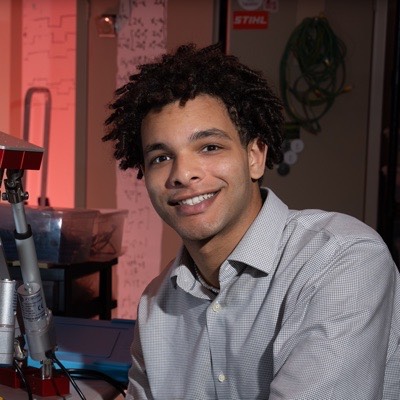
Brair (Tilboon) Elberier

I build tiny, battery-free robots that sense, move, and communicate on their own.

Now MilliMobile Vision — onboard intelligence for insect-scale robots

Research vision

Tiny robots. No batteries. No tethers. My goal is to build microrobots that are completely self-sufficient, and to challenge what we assume they can do in the real, unstructured world.

About

I am a Ph.D. student in Electrical and Computer Engineering at UCLA, advised by Ankur Mehta in the Laboratory for Embedded Machines and Ubiquitous Robots (LEMUR). I am also a National GEM Consortium Fellow and a graduate researcher at MIT Lincoln Laboratory.

My research develops hardware and software for low-power, autonomous microrobots built for resource-constrained settings: battery-free onboard actuation, wireless communication, remote sensing, computer vision, and state estimation. My work has appeared in Science Robotics and IEEE CASE.

I earned my B.S. in Electrical and Computer Engineering from the University of Washington, where I built battery-free origami microfliers in Vikram Iyer's lab and designed the secure communication protocol for the UW CubeSat team's SOC-I satellite as a NASA Space Grant recipient. I care deeply about teaching, and have taught embedded systems and Python to high school students through AVELA.

Research

Autonomy at the smallest scales.

Near-gram robots can enter gaps, cavities, dense vegetation, machinery, and damaged structures that conventional robots and people cannot, and they can be inexpensive enough to deploy in numbers. But at this size, each milligram of mass, milliwatt of power, and kilobyte of memory is a meaningful share of what the robot has. Sensing, computation, communication, power, and actuation all compete for the same few grams.

The question is not only how to miniaturize each component, but how to make the whole robot autonomous within that budget.

01 — Onboard perception

Perception that fits the compute budget

Track cheaply on every frame. Classify only when identity matters.

A single monochrome camera and a microcontroller must share memory and cycles with inference, the radio, and motor control. I design perception–control architectures that keep lightweight localization in the closed loop and invoke learned classification selectively, so perception never starves locomotion.

02 — Harvested energy

Operation on harvested energy

Shape behavior around the energy the environment provides.

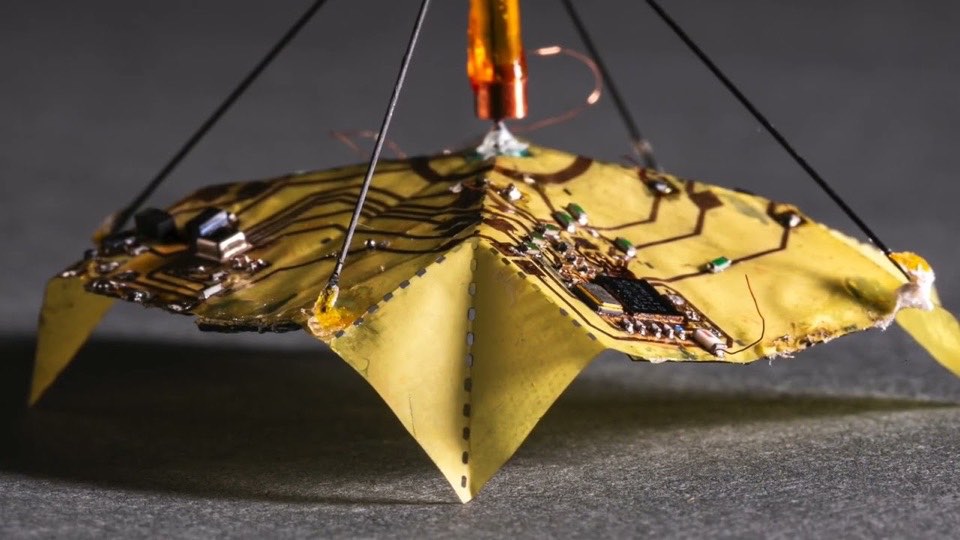
Batteries add mass and eventually run out. Battery-free platforms like the solar-powered origami microflier collect their own power and spend it in brief, deliberate actions, so energy availability becomes part of the operating strategy rather than a limit imposed on it.

03 — Physical understanding

Physical models from observation

Measure the world before predicting how to act in it.

Predicting how a robot will interact with its surroundings requires knowing their intrinsic properties. I use computer vision to capture motion, relate it to a physics-based model, and estimate the most probable parameters with Bayesian inference.

Featured · MilliMobile Vision · IEEE RA‑L, in preparation

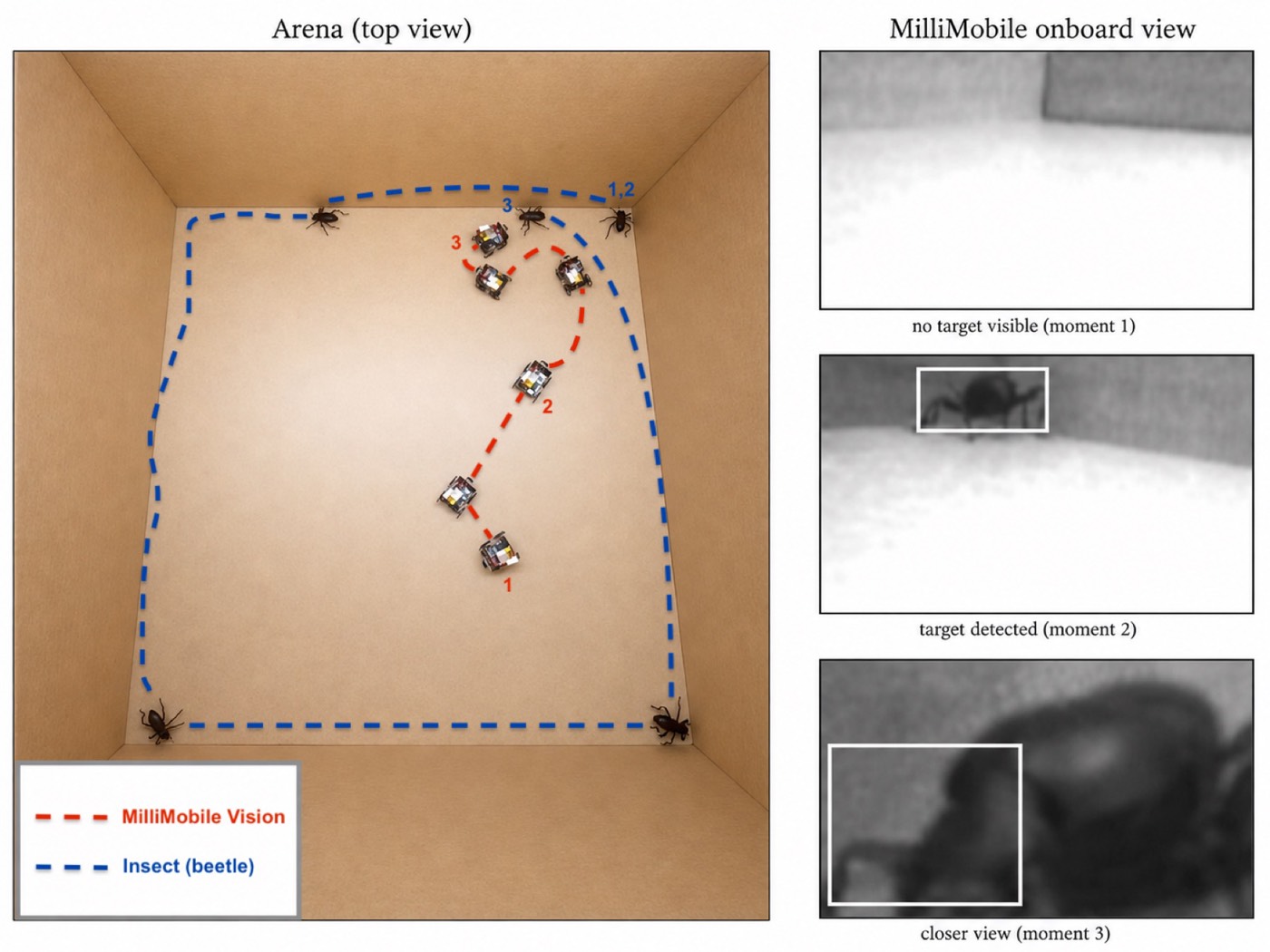
Search, identify, follow. Entirely onboard.

<4 g
total system mass
70 cm/s
maximum speed
27
insect classes identified onboard
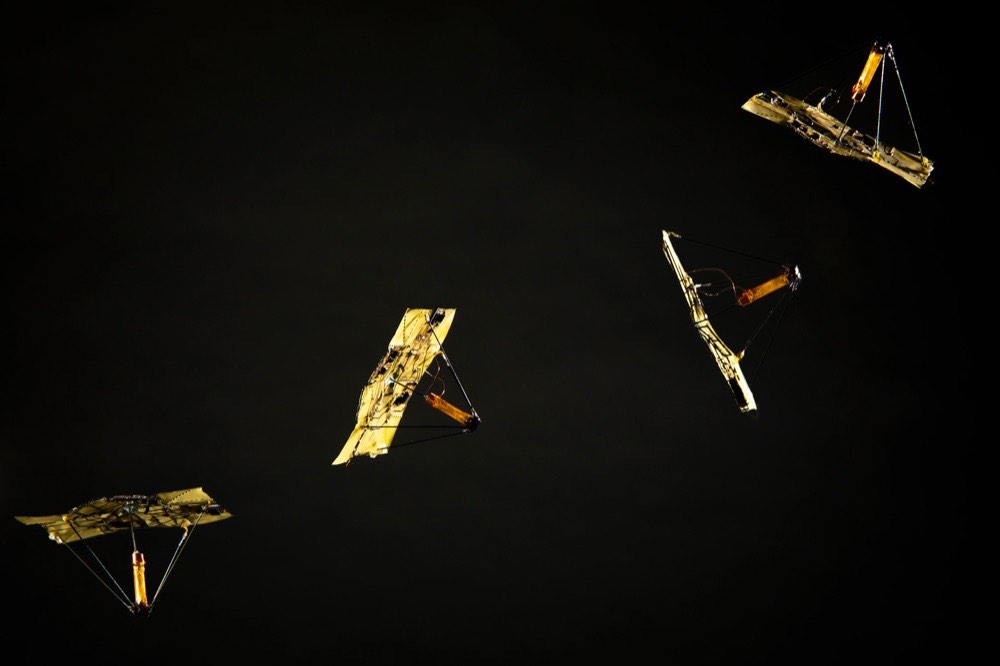
Time-lapse of an origami microflier changing shape as it falls

Featured · Origami Microfliers · Science Robotics 2023

Shape changes the fall. Sunlight powers the change.

414 mg
total system mass
98 m
outdoor dispersal distance
60 m
Bluetooth range on solar power

Selected Publications

Google Scholar
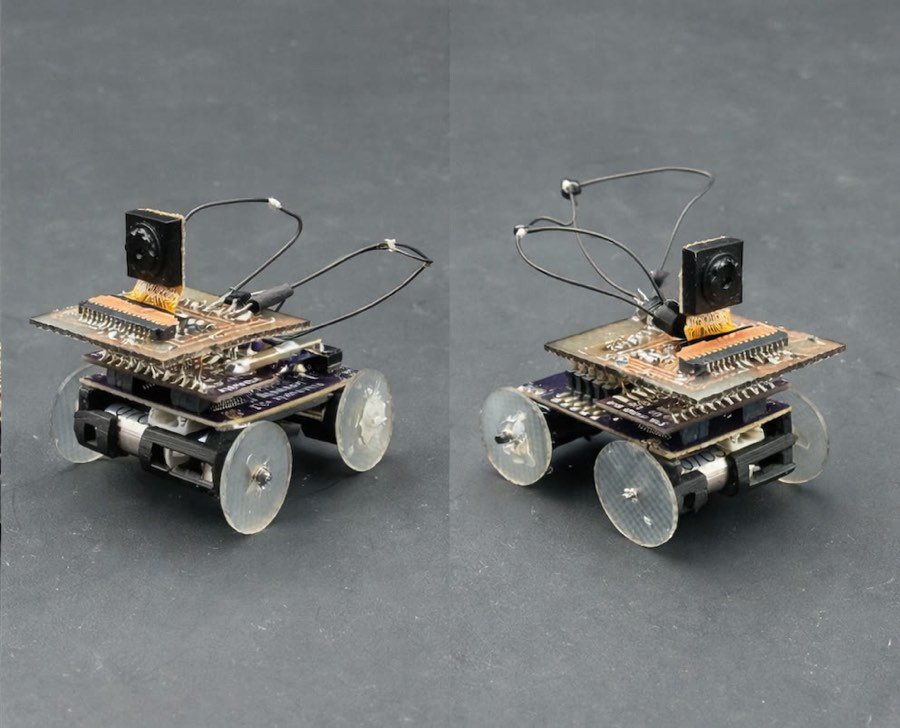
Two views of the MilliMobile Vision robot

In preparation

MilliMobile Vision: Onboard Intelligence for Insect-Scale Mobile Robots

B. T. Elberier, et al.

To be submitted to IEEE Robotics and Automation Letters (RA-L).

A <4 g, 2×2×2 cm platform that autonomously searches for, identifies, approaches, and follows a freely moving live insect using only onboard vision and computation.

Abstract

Vision-based autonomy can substantially expand the capabilities of insect-scale mobile robots, but integrating visual perception and control under strict size, weight, and power (SWaP) constraints remains challenging at the near-gram scale. At this size, camera capture, onboard inference, wireless communication, and motor control must share severely constrained computational and memory resources while maintaining perception rates sufficient for closed-loop behavior. We present MilliMobile Vision, an extensible mobile robotic platform that integrates onboard visual perception, inference, and closed-loop control within a system weighing less than 4 g and measuring 2×2×2 cm. The platform uses off-the-shelf components and an extensible hardware architecture with exposed interfaces for integrating additional sensors and peripherals, while its wheel-based locomotion enables speeds up to 70 cm/s. We develop a compute-aware perception–control architecture that separates lightweight visual detection and tracking from computationally intensive learned classification. Using only a single monochrome camera for environmental perception, lightweight image processing provides target localization and obstacle awareness for closed-loop navigation at approximately 3 Hz, while a 27-class neural network is selectively invoked for onboard insect identification with approximately 80% validation accuracy. Together, these components enable an untethered closed-loop task in which the robot autonomously searches for, identifies, approaches, and follows small moving targets using only onboard visual feedback and computation. This hierarchical perception strategy reserves learned inference for observations where semantic information is required, preserving visual feedback for responsive locomotion under constrained onboard compute and memory. We characterize the resulting perception latency, inference, and closed-loop control trade-offs and demonstrate sustained autonomous tracking of continuously moving targets, including a freely moving live insect.

CV-informed parameter estimation MAPE 3.96% m k, b, m KF(λₖ) Capture motion Physics model Bayesian inference video → time series S(λ) = {A, B, H, Q, R} MMAE → λ̂

Computer Vision Informed Parameter Estimation

M. Hernandez, B. T. Elberier, A. Mehta

IEEE International Conference on Automation Science and Engineering (CASE), 2025, pp. 3494–3499.

Estimates the parameters of a linear dynamic system directly from video, reaching 3.96% MAPE on data subject to additive white Gaussian noise.

Abstract

The proposed computer vision (CV) informed parameter estimation pipeline is capable of generating parameter estimates for a selected linear dynamic system. This is accomplished by (1) collecting a time-series dataset of a system's physical motion, (2) relating the captured motion to a designed physics-based model, and (3) estimating the most probable set of parameters that represents the observed motion using Bayesian inference. This analysis provides a fundamental understanding of the system's intrinsic properties that enables the refinement and generation of new system affordances. Leveraging this additional knowledge, external learning systems may use this physics-based approach to make predictions of a system's potential environmental interactions. We compare the results of our generalized approach with those of a handcrafted solution designed for a similarly constructed experiment. Our experiments reveal a MAPE of 3.962%, highlighting the approach's robustness given a time-series dataset subject to additive white Gaussian noise (AWGN).

Time-lapse of an origami microflier changing shape as it falls

Solar-powered Shape-changing Origami Microfliers

K. Johnson, V. Arroyos, A. Ferran, R. Villanueva, D. Yin, T. Elberier, A. Aliseda, S. Fuller, V. Iyer, S. Gollakota

Science Robotics, 2023.

Press: UW News · Allen School News

Abstract

Using wind to disperse microfliers that fall like seeds and leaves can help automate large-scale sensor deployments. Here, we present battery-free microfliers that can change shape in mid-air to vary their dispersal distance. We designed origami microfliers using bistable leaf-out structures and uncovered an important property: a simple change in the shape of these origami structures causes two dramatically different falling behaviors. When unfolded and flat, the microfliers exhibit a tumbling behavior that increases lateral displacement in the wind. When folded inward, their orientation is stabilized, resulting in a downward descent that is less influenced by wind. To electronically transition between these two shapes, we designed a low-power electromagnetic actuator that produces peak forces of up to 200 millinewtons within 25 milliseconds while powered by solar cells. We fabricated a circuit directly on the folded origami structure that includes a programmable microcontroller, a Bluetooth radio, a solar power–harvesting circuit, a pressure sensor to estimate altitude, and a temperature sensor. Outdoor evaluations show that our 414-milligram origami microfliers were able to electronically change their shape mid-air, travel up to 98 meters in a light breeze, and wirelessly transmit data via Bluetooth up to 60 meters away, using only power collected from the sun.

Posters & Presentations

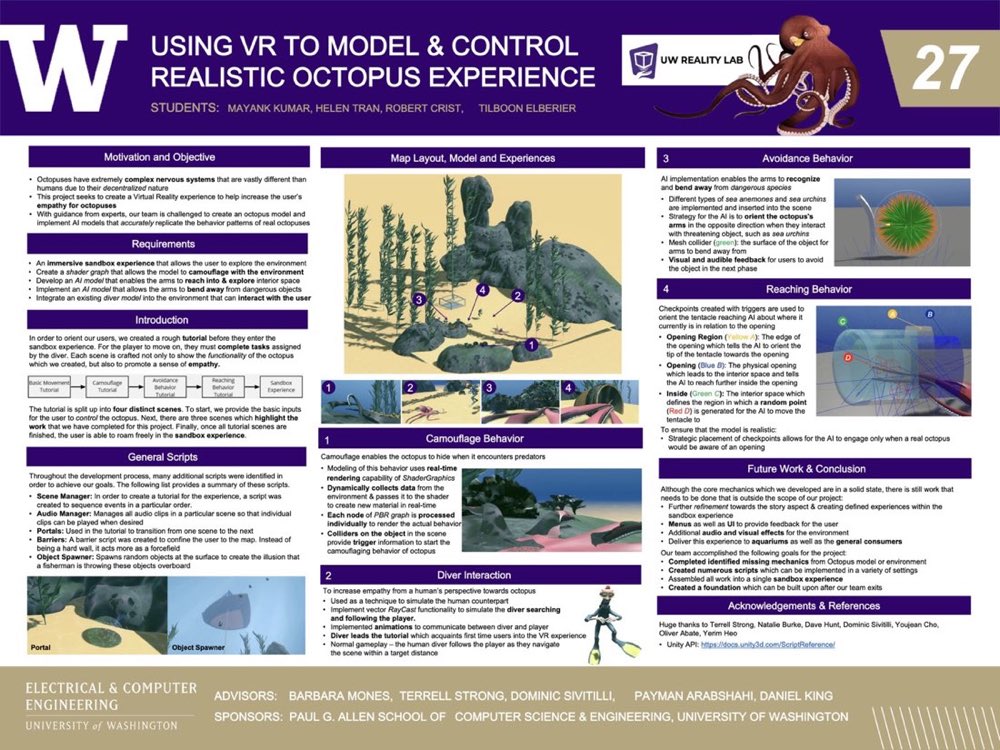
Using VR to Model & Control a Realistic Octopus Experience

M. Kumar, H. Tran, R. Crist, T. Elberier

Poster · Octopus Research Group, UW Reality Lab, 2022.

Presented at Education Soiree 2022: “Technologies in Search of a Purpose.”

Journey

From circuits to microrobots.

  1. 2025
  2. 2024
  3. 2023
  4. 2022
  5. 2021
  6. 2017

Teaching & Mentorship

Teaching the next engineers.

Teaching Assistant

  • UCLA ECE 180DA/DW — Systems Design Capstone
  • UW CSE 371 — Design of Digital Circuits and Systems
  • UW CSE 369 — Introduction to Digital Design
  • UW EE 393 — Advanced Technical Communications
  • UW GENST 199 — The University Community

Outreach & Service

  • AVELA instructor, Introductory Embedded Systems (Seattle Public Schools)
  • AVELA instructor, Intermediate Python Programming (Seattle Public Schools)
  • Speaker, UCLA ECE Graduate Orientation (2025)
  • Speaker, UW ECE Undergraduate Orientation (2021)
  • Curriculum Committee Representative, UW ECE (2021–2022)

Honors & Fellowships

  • 2024 National GEM Consortium Fellowship
  • 2022 NASA Space Grant
  • 2021 Boeing Emerging Leader Scholarship, UW College of Engineering
  • 2021 NACME Corporate Scholarship
  • 2021 Kenneth and Sylvia Steen Endowed Scholarship, UW ECE
  • 2021 Lawrence and Lucille Frey Endowed Scholarship, UW ECE
  • 2020 Arthur Burman Winter Endowed Scholarship, UW ECE
  • 2020, 2021 National Action Council for Minorities in Engineering Scholarship

Contact

Let's talk research.

I'm glad to discuss near-gram robotics, embedded perception, and potential collaborations.

tilboon@g.ucla.edu